
Widow & Survivor Pension Calculator
Estimate the survivor pension and lump sum payable to a spouse, partner or eligible child under AFPS 75, 05 and 15 if a member dies.
Your details
Scheme, pay & service
Your estimate
Pension, lump sum & EDP
EDP 05 (rises to 75% at 55)
How this is worked out
AFPS 05 accrues 1/70th of final pensionable pay per year, capped at 40 years of reckonable service. An EDP 05 income steps up to 75% of the preserved pension from age 55. Figures use published AFPS rates. See our methodology. Estimate only, not financial advice.
How the Survivor Pension estimate is worked out
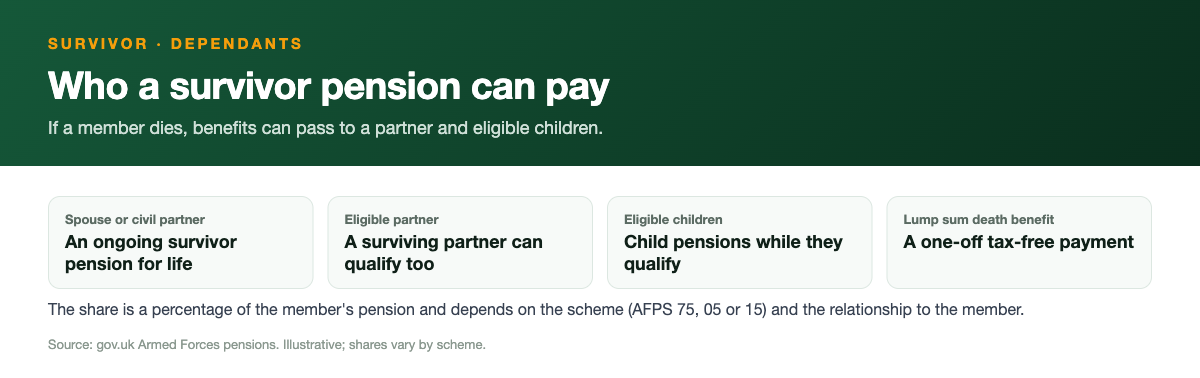
If a member dies, a survivor pension can be paid to a spouse, civil partner, eligible partner or child, usually as a percentage of the member's pension, alongside a lump sum death benefit.
The exact share depends on the scheme, AFPS 75, 05 or 15, and the relationship to the member. This tool gives a representative estimate of the ongoing income.
What a survivor pension actually pays
A survivor pension is the income the Armed Forces Pension Scheme pays to the people you leave behind if you die. In the 22 years I spent doing unit pay and pensions admin, this was the part of a pension brief that families remembered most, and the part most members had never thought about until they sat down to ask. The headline point is simple: your AFPS benefits do not stop dead when you do. A proportion carries on, usually for the rest of a spouse's or partner's life, and there is normally a one-off tax-free lump sum on top.
The exact amount depends on three things: which scheme you are in (AFPS 75, AFPS 05 or AFPS 15), whether you die while still serving, after leaving with a preserved pension, or once your pension is already in payment, and who qualifies to receive it. This calculator gives you an illustrative estimate of the spouse or partner pension and the death-in-service lump sum so you can see roughly what your family would receive. It is an estimate to help you plan, not an official award. Only Veterans UK can confirm the figure your family would actually be paid.
Throughout this page I use the figures from the scheme booklets and from this site's calculation engine. Where a precise percentage is not published for a particular case, I describe how it works rather than invent a number. Treat every worked figure here as illustrative.
Spouse, civil partner and eligible partner
A legally married spouse and a registered civil partner are treated the same way under all three schemes. There is no need to prove financial dependency and no need to nominate them: the entitlement is automatic once the relationship is recognised. This is the most straightforward survivor benefit and the one most members are picturing when they ask the question.
An eligible unmarried partner is a more recent addition and the rules are tighter. Under AFPS 15, and under AFPS 05 for service from 2005, a long-term partner who is not married or in a civil partnership can qualify, but the relationship has to be substantial and exclusive, the couple must be free to marry or form a civil partnership, and there is usually a financial interdependency test. The single most common mistake I saw was members assuming a partner was covered because they had lived together for years. Do not assume. Complete the relevant nomination or notification with JPAC so there is a clear record, because at the point of a claim your partner has to evidence the relationship and you will not be there to help.
The percentage of your pension that passes to a survivor differs by scheme. Under AFPS 15 the survivor receives 62.5% of your pension in the relevant case, for example 62.5% of your deferred pension if you have already left. Under AFPS 75 the long-term survivor pension is broadly half of the pension built up for service from 31 March 1973, and a smaller fraction for any service before that date. AFPS 05 sits between the two as a final-salary scheme with its own survivor terms; if you are in AFPS 05 the safest course is to request an official forecast so the exact survivor rate for your record is confirmed.
Children and other dependants
Eligible children get their own pension, paid on top of anything going to a surviving spouse or partner. A child generally qualifies up to age 18, or older if they stay in full-time education or training, and there is usually no upper age limit for a child who is permanently unable to support themselves because of disability. The money is there to help raise the family, not to replace the adult survivor pension.
The share depends on the scheme and on how many children there are, and on whether there is also a surviving adult. Under AFPS 15 the children's element is the balance after the spouse or partner is paid, broadly 37.5% shared between them, an only child with no surviving adult can receive 25%, and the maximum per child is one third. Under AFPS 75 the guideline is up to a quarter of the pension for one child, with the total shared between children where there are more. The structure is deliberately tiered so that a family with no surviving parent is not left worse off than one with a surviving spouse.
The practical lesson is to keep your service record up to date. Make sure every child, including stepchildren and children from a previous relationship who depend on you, is recorded correctly, because a child the scheme does not know about is a child who has to be evidenced from scratch at the worst possible time.
The lump sum death benefit
On top of the ongoing survivor pension there is a one-off tax-free lump sum if you die in service. This is the cash payment that gives a family breathing room in the first months, and it is significant. Under AFPS 15 the death-in-service lump sum is four times your final pensionable earnings. Under AFPS 75 it is three times your representative pay. These multiples are set by the scheme, not by length of service, so even a relatively junior member with a young family is protected from day one.
The lump sum is paid free of income tax and, because it is a registered pension scheme death benefit, it normally falls outside your estate for inheritance tax. Who receives it matters. The scheme administrator decides, but they are guided by your expression of wish, sometimes called a death benefit nomination. If you have named the people you want to benefit, the payment can be made quickly and cleanly. If you have not, it can take longer and may not go where you assumed.
If you have already left and your pension is in payment, the picture changes. Instead of a service lump sum you may have a guarantee that protects a number of years of pension, for example a balance paid if you die within a few years of your pension starting. The exact form depends on your scheme and how long you have been drawing the pension, which is another reason an official forecast is worth requesting.
A worked example (illustrative)
Here is an illustrative example using only round figures, to show how the numbers behave rather than to predict any real award. Imagine a member in AFPS 15 with a final pensionable salary of £40,000 and 20 years of service. Their own pension, built at 1/47th of pay each year, is roughly £40,000 times 20 divided by 47, about £17,000 a year. If they died after leaving with that preserved pension, a surviving spouse on the 62.5% rate would receive about £10,600 a year for life, paid monthly.
Now picture the same member dying in service. The death-in-service lump sum under AFPS 15 is four times final pensionable earnings, so four times £40,000, which is £160,000, paid tax-free to whoever the member nominated. A surviving spouse would also receive an ongoing survivor pension, and any eligible children would receive their element on top. The lump sum alone is the kind of figure that clears a mortgage and steadies a household while the family finds its feet.
These numbers are illustrative and rounded. Your real salary, exact service, scheme and family circumstances will move them, and the in-service survivor pension is calculated from an enhanced ill-health figure rather than the simple deferred pension, so do not treat the example as a quote. Use it to understand the mechanics, then use the calculator above with your own figures, and confirm anything that matters with Veterans UK.
How survivor benefits are taxed
The two parts of the benefit are taxed differently, and getting this clear saves a lot of worry. The ongoing survivor pension is taxable income in the hands of the person who receives it, exactly like any other pension. It is paid through PAYE with a tax code, so a survivor with little other income may pay little or no tax on it, while one who is still working will see it taxed alongside their salary.
The lump sum death benefit is normally paid tax-free and, as a registered pension scheme benefit, sits outside the estate for inheritance tax in most cases. That combination is one of the most valuable features of the scheme and a strong argument for keeping your expression of wish current, because the tax treatment is most efficient when the administrator can pay the people you intended without the money first passing through your estate.
Survivor benefits are also separate from any State Pension or bereavement support a partner may claim from the government. The AFPS survivor pension does not replace those and is not reduced because of them, although they are taxed and assessed in their own right. If your survivor's wider finances are complicated, that is the point to take regulated financial advice, which this site does not provide.
How a survivor makes a claim
When a serving or former member dies, the survivor pension is not automatic in the sense of arriving without action. Someone has to tell the scheme and start the claim. For a serving death, the unit and the chain of command will normally begin the process and a casualty or visiting officer will help the family. For a death after leaving, the family contacts Veterans UK directly, and it helps enormously if they know which scheme the member was in and have the service or pension reference to hand.
The scheme will ask for documents to establish entitlement: the death certificate, a marriage or civil partnership certificate for a spouse, evidence of the relationship and of financial interdependency for an eligible partner, and birth certificates and proof of education for children. This is exactly why I push members so hard to keep nominations and records current while they are alive. Every gap you leave is a delay your family has to close while grieving.
Keep a simple folder, physical or digital, with your scheme details, your latest annual benefit statement or forecast, your expression of wish, and the family certificates. Tell your spouse or partner where it is. A serving member can request an official forecast on form 12 and a person with a preserved pension on form 14, and getting one now means your family is not starting from nothing later.
Check your own position and next steps
Start by confirming which scheme or schemes you are in. Most serving members today are building AFPS 15, but if you served across the McCloud remedy period, 1 April 2015 to 31 March 2022, part of your record may sit in a legacy scheme and your survivor terms for that slice follow the legacy rules. From 1 April 2022 everyone serving builds AFPS 15. Knowing the mix tells you which survivor percentages apply to which part of your benefit.
Next, check that the people you care about are actually recognised. A spouse or civil partner is covered automatically, but an unmarried partner and any non-obvious children are not, so complete the partner notification and the death benefit nomination with JPAC and review them after any major life change, a marriage, a new child, a separation, or a house move. These are five-minute jobs that decide whether your family gets paid quickly or has to fight for it.
Finally, use the calculator above to get an illustrative estimate, then request an official forecast from Veterans UK, form 12 if you are still serving or form 14 if you hold a preserved pension. This site is independent and not affiliated with the MOD, Veterans UK or JPAC, and these figures are estimates rather than regulated financial advice. For anything that will shape a real decision, the official forecast is the document that counts.
Frequently asked questions
Estimate only. These figures use published AFPS rates and the 2026 increase (3.8% CPI) to give a guide, not a formal forecast. See how we calculate for the exact method and assumptions.
Survivor & widow pensions explained
Who qualifies, how much is paid, and the lump sum death benefit.
James Hartley
James Hartley spent 22 years in the British Army, including unit personnel administration and pensions and records duties, and now writes the scheme guides and scenario pages on this site. He is not a regulated financial adviser, so the content is general information rather than personal advice.
Sources: gov.uk Armed Forces pensions · GAD factors · Veterans UK · MoneyHelper.