
Military Pension Divorce Calculator (UK)
Work out roughly what a UK military pension is worth before a pension sharing order on divorce. Enter your scheme, pay and service to size an armed forces pension under AFPS 75, 05 or 15, and see what a given percentage share would look like. Read on for what cannot be shared, what Veterans UK charges, and the different rule in Scotland.
Your details
Scheme, pay & service
Your estimate
Pension, lump sum & EDP
EDP 05 (rises to 75% at 55)
How this is worked out
AFPS 05 accrues 1/70th of final pensionable pay per year, capped at 40 years of reckonable service. An EDP 05 income steps up to 75% of the preserved pension from age 55. Figures use published AFPS rates. See our methodology. Estimate only, not financial advice.
How the Pension on Divorce estimate is worked out
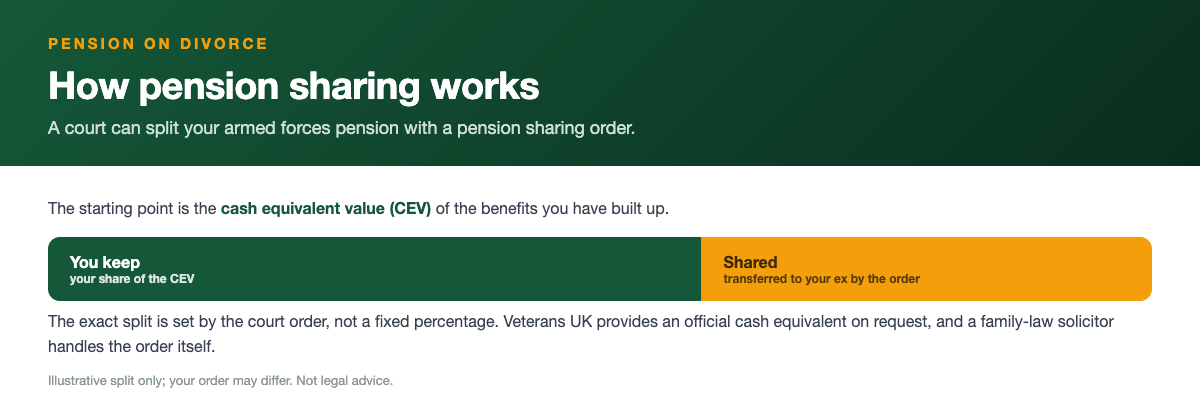
On divorce, the courts can make a pension sharing order that transfers part of one spouse's armed forces pension to the other. The starting point is the cash equivalent value of the benefits built up.
This estimate helps you understand the scale of the pension before formal valuations. Veterans UK provide an official cash equivalent on request, and a family-law solicitor handles the order itself.
How divorce affects an armed forces pension
When a marriage or civil partnership ends, the armed forces pension is treated as a financial asset that the court can divide, in the same way as a house, savings, or investments. For many serving personnel and veterans it is the single largest asset they own, often worth more than the family home. What is in scope depends on where you are divorcing. In England, Wales, and Northern Ireland the whole value built up under AFPS 75, AFPS 05, or AFPS 15 is on the table, not just the slice earned during the marriage. Scotland is genuinely different: under sections 10(4) and 10(5) of the Family Law (Scotland) Act 1985, only the proportion of the pension built up between the date of the marriage or civil partnership and the relevant date counts as matrimonial property, so service before the marriage and after separation is out of scope. How much of the value in scope actually gets shared is then a matter for negotiation and the court.
This calculator gives you an early, rough estimate of what an armed forces pension is broadly worth and how a share of it might look. It is a starting point for understanding your position before you instruct solicitors, not a formal valuation and not financial advice. The figures are illustrative and based on the published scheme rules and constants on this site, so they will not match, to the penny, the official cash equivalent value that Veterans UK provides later in the process. For the law, the three routes, the forms, and the steps in order, read the armed forces pension on divorce guide alongside this tool.
One thing worth saying up front: divorce does not automatically split a pension. Nothing happens to the pension at all unless a court order specifically directs it, or unless the parties agree to offset its value against other assets. A serving member can keep building AFPS 15 benefits throughout the process, and a veteran already drawing a pension keeps receiving it, until and unless an order takes effect.
What a pension sharing order is
A pension sharing order is the main tool the courts use to divide a pension on divorce, and the thing to be clear about before you use the calculator is what the ordered percentage is applied to. It is applied to the cash equivalent value of the pension, the single capital figure that sits behind the benefits, and not to the yearly pension figure on your statement or forecast. In England, Wales, and Northern Ireland the share is always expressed as a percentage, set by the court or agreed between the parties and applied to that value at a particular date. Scotland is the exception: only Scottish law lets an order specify a monetary amount instead, under section 29(3) of the Welfare Reform and Pensions Act 1999, and Veterans UK converts that amount into a percentage of the valuation, rounded to the nearest whole percentage, before implementing it. So in every jurisdiction the figure that finally bites on your AFPS benefits is a percentage of a capital value, and that is the percentage to enter above.
Under the armed forces schemes, a pension sharing order always makes the former spouse a pension credit member of the scheme, with their own pot inside the AFPS arrangement and their own rules about when it can be drawn, while the member's own pension is permanently reduced by a matching pension debit. Sharing is not the only route, and attachment and earmarking are not two names for the same thing: an attachment order is available in England, Wales, and Northern Ireland, an earmarking order is the Scottish route and can only be made against a pension lump sum, and offsetting is available everywhere. The armed forces pension on divorce guide compares all three and explains when each is used. This calculator models the sharing route only, because it is the one that turns a percentage into a pension of the former spouse's own.
The AFPS cash equivalent value (CEV) and what this calculator models
The calculator estimates the broad value of an armed forces pension from the published AFPS accrual rules, then applies the share you enter to it. For AFPS 05 that is 1/70th of final pensionable pay for each year of service, capped at 57%, with an automatic tax-free lump sum of 3 times the annual pension. For AFPS 15 it is 1/47th of pensionable pay banked each year and revalued for inflation. That gives you the rough scale of the benefit a share would be taken from, and the rough scale of what a given percentage would move across.
What the tool cannot do is reproduce the factors Veterans UK actually works from. The official cash equivalent value, which the MOD and Veterans UK shorten to CEV, is produced by Veterans UK using tables of actuarial factors supplied by the Government Actuary's Department, against your exact service record, your scheme, and your normal pension age, and it may carry a McCloud remedy adjustment as well. The armed forces pension on divorce guide explains who produces that figure, which form it comes on, and how to request it.
It helps to know why an AFPS cash equivalent looks so large next to the annual pension. A defined benefit pension promises a guaranteed, inflation linked income for the rest of your life, plus benefits for survivors, and replacing that promise on the open market would be very expensive, so the capital value behind even a modest looking annual pension is often substantial. That is why the pension frequently dwarfs the other assets in a service divorce, and why a small percentage error on a large number is a large amount of money.
One practical point for using the tool. There is no single figure covering a whole career, because Veterans UK produces a separate cash equivalent value for each armed forces scheme you have been in. If your service spans AFPS 75 or AFPS 05 and AFPS 15, run the calculator once for each period and read the results side by side rather than looking for one combined number, because that is how the official valuation, and any resulting pension credits, will arrive.
How the AFPS benefits are actually split
When a pension sharing order is implemented, the scheme administrator applies the ordered share to the cash equivalent and creates a pension credit for the former spouse, then reduces the member's benefits by a corresponding pension debit recorded against their record. So if an order shares 40% of the value, the former spouse holds that 40% as their own pension credit, and as a guide to scale the member is left with something like the remaining 60%. Both halves are revalued under the scheme rules, so neither is frozen at the divorce date.
The debit is worth understanding properly, because it is not simply a slice taken off the top of a pot. MMP131 describes it as an annual amount deducted from the pension once it comes into payment, and says the size of that deduction depends both on the value of the credit and on how many years the deduction is spread over, so a debit spread over more pension years is smaller each year. That has a real consequence: the debit is recalculated if the assumption about when the member's pension starts turns out to be wrong. An AFPS 05 member assumed on Transfer Day to be heading for a pension at 65, who then serves to the immediate pension point, has the debit spread over a longer period, so it shrinks and the pension is higher than first forecast. A member already past that point on Transfer Day who serves on has it spread over a shorter period, so the debit grows and the pension is lower than anticipated. Any estimate you make now, including ours, assumes a fixed retirement age and cannot capture that.
The split applies to the core pension benefits, and in the final salary schemes that includes the automatic tax-free lump sum that comes with them. Under AFPS 75 and AFPS 05 the pension carries an automatic lump sum of 3 times the annual pension, so when the pension value is shared, that lump sum value is part of what is being divided. AFPS 15 has no automatic lump sum, although a member can commute part of the pension to cash at the fixed rate of about 12 to 1. The order works on the capital value, so the mechanics differ between schemes even though the principle is the same.
Survivor benefits sit inside this framework too. Once a couple are divorced, an ex spouse is no longer entitled to the scheme's automatic widow, widower, or surviving partner pension, because that protection is tied to the relationship. The sharing order is what replaces it with a secure entitlement of the former spouse's own, which is the strongest reason to formalise the position rather than rely on an informal understanding that gives them no protected right at all.
What cannot be shared: EDP, AFCS, and War Pension
Not everything a service leaver or veteran receives can be divided, and this is the biggest gap in most general divorce advice. MMP131, the MOD's own booklet on pension benefits on divorce and dissolution, states that payments received under the Early Departure Payment scheme, the Armed Forces Attributable Benefits scheme, the War Pension scheme, and the Armed Forces Compensation Scheme are excluded from being shared or attached, because they are not pension benefits. Paragraph 7.3 adds Resettlement Grants to that list and says Veterans UK cannot be instructed to pay these sums to anyone other than the scheme member. A pension sharing order, an attachment order, and a Scottish earmarking order can therefore only bite on the pension itself.
The Early Departure Payment is the one that catches people out, because for many leavers it is the largest cash flow in the years immediately after service. MMP131 is blunt about it: the AFPS 05 EDP is not a pension, a sharing order cannot be applied against it, and no debits are taken from it. The AFPS 15 EDP is treated the same way, and the guidance notes that the legislation implementing the EDP prevents attachments being made to it. The EDP is paid to the member in full until it stops and the pension begins, and the debit starts at that point. If you are using our EDP calculator alongside this one, treat the EDP income and the EDP lump sum as outside the sharing arrangement, and the pension underneath as the thing that actually gets divided. The same logic applies to a resettlement grant.
Compensation is excluded for the same reason. An AFCS lump sum, a Guaranteed Income Payment, a survivor's GIP, a War Pension, and any Armed Forces Attributable Benefits award cannot be made the subject of a sharing, attachment, or earmarking order. Pension sharing reaches only shareable rights under a pension arrangement, under section 27(1) of the Welfare Reform and Pensions Act 1999, and a compensation scheme is not a pension arrangement. In the AFCS case there is a second lock: article 69A of the Armed Forces and Reserve Forces (Compensation Scheme) Order 2011 makes any assignment or charge over an award void. What the court can still do is take these payments into account as a financial resource when it weighs an offsetting settlement, and MMP131 says exactly that. Being counted as income and being divisible are two different things, and only the second is ruled out.
What Veterans UK charges, and how long a CEV takes in 2026
Veterans UK charges for divorce work, and the charges are published rather than discretionary. Under the Pensions on Divorce etc. (Charging) Regulations 2000 the scheme has to tell you in writing that it intends to recover its costs, and give you a written schedule of charges, before a sharing order is made. In outline: a valuation produced specifically for divorce is 150 pounds plus VAT, setting up the member's debit record and the former spouse's new pension credit record once an order arrives is a set 300 pounds plus VAT per pension account, an extra written reply short of a reassessment is 75 pounds plus VAT, and an attachment or earmarking order is 150 pounds plus VAT. Basic scheme information is free, and members get one free valuation in any 12 month period, though not where the member has already retired or is within 12 months of retirement age, which is exactly the population most likely to be divorcing with a pension in payment. The court decides who pays, and where the order is silent section 41(3)(b) of the Welfare Reform and Pensions Act 1999 puts the charge on the member. Every figure attracts VAT at the standard rate, and they all come from a charging leaflet dated 1 September 2016 that is still the published version and reserves the right to review the charges, so confirm them with Veterans UK before budgeting.
Timescales in 2026 need planning for. Veterans UK was unable to process any CEV applications at all between 19 May 2026 and 23 July 2026, because the Government Actuary's Department had to rebuild the actuarial factors after the SCAPE discount rate changed on 19 May 2026 from CPI plus 1.7% a year to CPI plus 2.0% a year. Processing restarted on 23 July 2026, working through the backlog in order of the date requests were received, and the MOD says it cannot give a definitive timescale for when a given CEV will arrive. Gov.uk's own two documents then disagree about the current wait: the 2015 Pension Remedy divorce information note, updated 24 July 2026, says new requests are taking up to 3 months to process, while AFPS Form 19 at revision 07/26 says up to 6 months, and both are current official documents. The statutory backstop behind them is 3 months from the request, or 6 weeks if you have told the scheme the information is needed in connection with proceedings, or shorter if the court orders it. Plan on months rather than weeks, ask early, and remember a CEV is generally only valid for a year. Nobody has published what the rebuilt factors do to AFPS values, so do not assume a CEV issued after 19 May 2026 will be higher or lower than one issued before it, only that it may be different.
The McCloud remedy, credit top-ups, and the cases stuck right now
If the pension being shared includes service between 1 April 2015 and 31 March 2022, the McCloud remedy runs straight through the middle of it, and the pivot date is 1 October 2023. Where a sharing order was based on a CEV issued before 1 October 2023, the scheme goes back and recalculates. It works out what the CEV and the pension credit would have been under the remedy, and where the alternative pension credit would have been higher, the scheme manager must pay the difference as a top-up into the former spouse's pension credit account. That is the single remedy fact a former spouse is most likely to need and least likely to have been told, and nobody has to go back to court for it, because the order itself is not reopened. Where the former spouse holds credits in more than one scheme they choose which account receives the top-up. No further charge is levied where the recalculation is needed because the CEV predates 1 October 2023.
On the member's side it is the debit that is recalculated, not the order that is rewritten. The principle the MOD applies is that the debit should reflect the percentage the court awarded in relation to benefits accrued during the remedy period, whichever scheme happens to be named on the order annex. Where the CEV is produced on or after 1 October 2023, the administrator values the remedy period rights twice, once as though they sat in the legacy scheme and once as though they sat in AFPS 15, and the higher of the two values is the figure given to the court. The remedy rules apply to any shareable rights earned in the remedy period regardless of when the order was made or took effect. The McCloud remedy guide and the McCloud remedy calculator explain how the underlying choice works.
The usual advice, to settle your remedy position before an order is finalised, is sound in principle, but as at August 2026 it is not available to everyone. The MOD's divorce information note records that a pensioner who has not yet made a remedy election cannot be given a CEV at all, because the necessary changes to the calculation method have not been implemented and the timeframe is not known, and some members with reservist service are in the same position. Where the member was already a pensioner on Transfer Day, the methodology to calculate the sharing order cannot be implemented, so those cases cannot be progressed, and the MOD warns that debits will later be applied retrospectively, creating an overpayment that is then recovered. Where an order was implemented during the remedy period covering both legacy and reformed benefits, legacy benefits are being paid for now without the debit, again with recovery to follow. Members who left service on or after 31 March 2026 cannot have an order implemented until the 2026 pay award has been applied. EDP payments are not affected by that recovery. If you are in one of these groups, tell your solicitor early that the valuation or the implementation may be blocked.
A worked example (illustrative only)
Here is an illustrative example to show the mechanics, using only the figures published on this site. Imagine a veteran in AFPS 05 with a preserved annual pension worth around 12,000 pounds a year, which carries an automatic tax-free lump sum of 3 times that pension, so 36,000 pounds. The capital value behind that guaranteed, inflation linked income for life is what the cash equivalent would capture, and it would be considerably more than the annual figure suggests because it represents decades of future payments.
Suppose the court approves a pension sharing order of 30%. The scheme would create a pension credit for the former spouse worth 30% of the cash equivalent, and apply a matching debit to the veteran's record. As a guide to scale, the veteran is left with something like the remaining 70% of the value. The actual mechanism is narrower than that picture: the debit is an annual deduction from the pension in payment, sized on the value of the credit and on how many years the deduction is spread over, and it is recalculated if the assumed retirement age changes. The former spouse holds their 30% credit as an independent pension, uprated in line with CPI from the Transfer Day and increased every April, so neither portion stands still.
One detail this example turns on, which most guidance leaves out, is whether the credit carries a lump sum of its own. Under AFPS 75 rule D.16(1) and AFPS 05 and RFPS 05 rule D.3, a pension credit member is entitled to a pension for life plus a lump sum of three times the annual pension, unless the member was already a pensioner member when the order took effect, in which case no lump sum is payable with the credit. Our veteran holds a preserved pension and is not yet drawing it, so a credit created now would carry a lump sum. Had the same veteran already retired and been in payment on the Transfer Day, an identical 30% share would produce a credit with no lump sum attached. AFPS 15 is different again: there is no automatic lump sum for anyone, although a credit member can commute part of the pension.
The numbers above are deliberately round and the percentage is just an illustration. Your real position depends on your exact scheme, your length of service, your normal pension age, whether you are affected by the McCloud remedy for service between 1 April 2015 and 31 March 2022, and the GAD factors in force when the cash equivalent is calculated.
What this armed forces pension estimate gives you versus a formal Veterans UK valuation
It is important to be clear about what this tool is and is not. The calculator produces an estimate based on the published AFPS accrual rules and the constants on this site. It is a free, fast way to understand the rough size of the pension and how a percentage share would look, so you can have an informed conversation with your solicitor. It is not regulated financial advice, it is not a legal valuation, and it is not affiliated with the Ministry of Defence, Veterans UK, or JPAC.
The figure the court relies on is the official cash equivalent value from Veterans UK. That valuation uses your individual service record, your exact dates, your scheme membership, your normal pension age, and the current Government Actuary's Department factors, none of which a public calculator can fully reproduce. The divorce valuation is requested on Form 19, whether you are still serving or hold a preserved pension. Form 12 and Form 14 give you a pension forecast, which is a projection of your own benefits rather than a valuation, and neither is a CEV or something a court will work from.
One thing the estimate does not model is tax. The figures here are gross scheme values. A sharing order is not itself a taxable event: it moves pension value across, and each party is then taxed in the normal way on the pension income they eventually draw, with the automatic lump sums under AFPS 75 and AFPS 05 keeping their tax-free status within the usual HMRC rules. There is also a later trap on the member's side, when a recalculated pension debit pushes the annual pension up and that increase is picked up in the annual allowance calculation, which no calculator can show you and which the armed forces pension on divorce guide sets out in full.
Think of it like this: our estimate tells you whether you are dealing with tens of thousands or hundreds of thousands of pounds, and helps you spot if something looks badly out of line. The Veterans UK valuation gives you the precise, court ready figure. You need both, in that order, because arriving at the formal stage already understanding the asset reduces the risk of agreeing a settlement that does not reflect what the pension is really worth.
Frequently asked questions
Estimate only. These figures use published AFPS rates and the 2026 increase (3.8% CPI) to give a guide, not a formal forecast. See how we calculate for the exact method and assumptions.
Armed forces pension on divorce
Pension sharing orders, the cash equivalent value, and how AFPS is split.
James Hartley
James Hartley spent 22 years in the British Army, including unit personnel administration and pensions and records duties, and now writes the scheme guides and scenario pages on this site. He is not a regulated financial adviser, so the content is general information rather than personal advice.
Sources: gov.uk Armed Forces pensions · GAD factors · Veterans UK · MoneyHelper.