
Medical discharge and ill-health pension explained
If you are discharged on medical grounds, you may receive an enhanced ill-health pension that is paid straight away, whatever your age, rather than a preserved pension you wait years to draw, which the preserved pension calculator will estimate. How much you get is set by a tier system that reflects how much your condition affects your ability to work, and the higher tiers add notional service to boost the figure. This guide explains the tiers, what the enhancement does, and how the award is decided, but the formal figure always comes from Veterans UK after a medical assessment.
Key takeaways
- A medical discharge can give an ill-health pension paid immediately, regardless of your age.
- The amount depends on a tier, which reflects how badly your condition affects your capacity for work.
- Higher tiers add notional extra service, so the pension and lump sum are enhanced beyond what you actually served.
- If your condition was caused by service, you may also have a separate Armed Forces Compensation Scheme claim.
- The tier and the award are decided by Veterans UK after a medical assessment, not by a calculator.
- The estimate here is a guide only; your formal award comes from Veterans UK.
What an ill-health pension is
An ill-health pension is the benefit paid when you have to leave the forces because a medical condition makes you unfit to continue serving. Unlike a normal early departure, it is paid immediately rather than preserved until pension age, which is the single most valuable feature, because it can mean decades of extra income.
The point of the tier system and the enhancement is to recognise that someone forced out by ill health has lost the chance to keep building their pension, so the schemes top up what they had earned so far rather than simply paying the bare amount accrued to the discharge date.
It is worth being clear that a medical discharge is a decision about your fitness to serve, made by the services, while the pension that follows is administered separately by Veterans UK. The two are linked but not the same, and the size of any ill-health award is not automatic; it follows from how your condition is assessed against the scheme's tiers.
Who qualifies and how it differs from a normal pension
An ill-health award applies when you are discharged because a medical condition makes you permanently unfit for service, rather than leaving by choice or at the end of an engagement. The defining feature is that the pension comes into payment immediately, whatever your age, instead of being preserved until 60, 65 or State Pension age.
That immediate payment is what makes the award so much more valuable than a preserved pension of the same headline size, because it can be drawn for decades longer. Two people with identical service can end up in very different places depending on whether they leave on medical grounds or simply resign, which is why the assessment carries so much weight.
You still generally need to have served long enough to have pension benefits in the first place, but the tiers and the enhancement are designed so that someone forced out early is not penalised for the years they never got the chance to serve.
How the tiers work
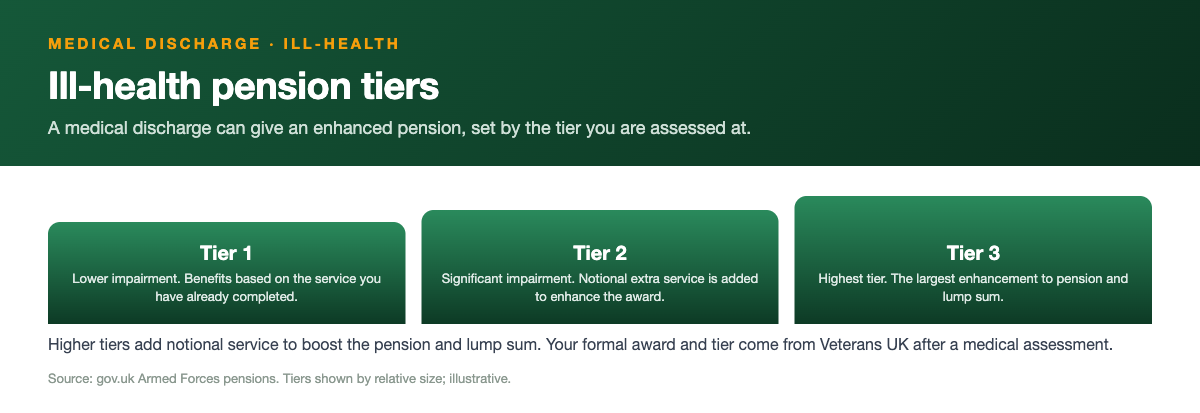
Your award is set by a tier that reflects how much your condition reduces your ability to do civilian work. A lower tier, broadly for those who can still work in some capacity, pays a pension based largely on the service you had actually completed. A higher tier pays an enhanced pension with notional extra service added on top.
The exact tiers and their names differ by scheme, AFPS 75, 05 and 15 each express them slightly differently, and the boundary between them is a clinical judgement. That is why two people with the same length of service can receive very different awards, and why the assessment, not the calculator, decides the outcome.
Broadly, the lowest tier recognises that a condition ends a military career but leaves a reasonable capacity for civilian work, so it pays close to the benefits earned to date. The middle tier applies where your capacity to carry on your own occupation is significantly impaired. The top tier applies where you are incapable of gainful employment generally. That distinction matters, because the two tests are not the same and the middle one is the lower bar.
The middle tier test changed on 11 June 2026
Under AFPS 15 the middle tier rule used to ask whether you were incapable of any gainful employment. That is the top tier test, and putting it inside a rule about significant impairment was a drafting defect that MOD has now corrected. The rule now asks whether your capacity to carry on your own occupation is significantly impaired, which is a materially lower bar and is likely to bring people into the middle tier who were previously refused.
The correction is backdated to 1 April 2015, so it is not only about new cases. If you were assessed against the old wording and placed in the lowest tier, or refused an enhanced award, your case was decided on a test that has since been changed.
The same regulations gave a review right to a group that never had one: people who took an early departure payment instead of a lowest tier ill-health award. If that was you, you can now ask for your case to be reviewed. Note that where a review succeeds on the basis that your condition has deteriorated, the award runs from the date you asked for the review, not from the date of your medical discharge. So if your condition worsens, ask early. Waiting costs you the period before you asked.
The exact boundaries and labels rest on clinical evidence rather than a formula you can apply yourself.
Enhancement and the lump sum
Where a higher tier applies, the scheme credits you with notional service you did not actually complete, which lifts both the annual pension and, on the schemes that pay one, the automatic lump sum. The effect is to move your figure closer to what you might have earned had you been able to serve on, rather than leaving you on the smaller amount earned to the discharge date.
If your condition was caused or made worse by service, you may also be able to claim under the Armed Forces Compensation Scheme, which is a separate compensation award and not part of your pension. The two can sit alongside each other, so it is worth checking both rather than assuming the pension is the whole story.
How much notional service is added, and how it feeds into the pension and any lump sum, depends on the scheme and the tier, so the uplift is not a fixed percentage you can assume. The principle is consistent, that a higher tier moves your award towards what fuller service would have produced, but the figure itself comes out of the assessment.
How the ill-health pension is paid
An ill-health pension is paid as a regular income for life, in the same way as any other AFPS pension, and on the final-salary schemes it usually comes with the automatic tax-free lump sum of three times the annual pension. On AFPS 15 there is no automatic lump sum, though commutation can provide tax-free cash in the usual way.
The income is taxable like any pension, so the headline figure is gross. For someone leaving service unexpectedly, that distinction matters when working out what the household will actually have to live on month to month.
Once in payment, the pension is uprated each year in line with prices, so it keeps its value over what may be a very long retirement. That annual increase, combined with the immediate start, is what makes a higher-tier award such a significant lifelong benefit.
The Armed Forces Compensation Scheme
If your condition was caused or made worse by your service, you may have a separate claim for compensation, and which scheme handles it depends on when the service that caused it took place. For service on or after 6 April 2005 that is the Armed Forces Compensation Scheme. For service before that date it is the War Pension Scheme, which assesses a degree of disablement and pays a weekly tax-free pension rather than a tariff lump sum. Either way it is distinct from your pension, with its own awards and its own application process, and AFCS versus War Pension sets out the border if you are not sure which applies.
The two can run alongside each other, so an ill-health pension and a compensation award are not alternatives you have to choose between. A Guaranteed Income Payment under AFCS, for the more serious awards, provides an ongoing tax-free income on top of the pension, which is why it is worth pursuing both rather than stopping at the pension. Note that a medical discharge pension for the same condition is offset against the GIP, so the total is not simply the two added together.
On the War Pension side there is a further layer that people routinely miss: the weekly pension is only the base, and a set of supplementary allowances sits on top of it. If your condition severely affects your ability to walk, the War Pensioners' Mobility Supplement is worth £89.25 a week from 6 April 2026, and it is paid on top of the disablement pension rather than instead of it. Allowances of this kind are not awarded automatically, so they are worth checking against your own condition when you claim.
Because the compensation side turns on showing that service caused the condition, it often benefits from specialist help. A service charity or a solicitor experienced in military claims can make a real difference to an AFCS application, particularly where the link to service has to be evidenced.
How the award is decided and what to do
The tier and the final figures are decided by Veterans UK following a medical assessment of your condition, so the numbers are not something you can set yourself or read off a calculator. Use the medical discharge calculator here to get a rough sense of the scale, then rely on the formal award for anything you need to plan around.
Because a medical discharge often happens quickly and at a stressful time, it is worth getting help. Your unit, a service charity, or a regulated adviser can help you understand the offer, and the compensation side in particular benefits from specialist input. This site is independent, not affiliated with the MOD or Veterans UK, and provides estimates rather than regulated advice.
Keep copies of your medical records and any assessment paperwork, because they are the basis of both the tier decision and any compensation claim. If you think the tier you have been given does not reflect your condition, there is a process to ask for it to be reconsidered, and again this is a point where a service charity or a specialist adviser can help you make the case.
See your own numbers
Get your pension, lump sum and EDP in seconds.
Frequently asked questions

James Hartley
James Hartley spent 22 years in the British Army, including unit personnel administration and pensions and records duties, and now writes the scheme guides and scenario pages on this site. He is not a regulated financial adviser, so the content is general information rather than personal advice.
Sources: gov.uk · GAD factors · Veterans UK · Forces Pension Society · MoneyHelper.