
AFPS Added Pension Calculator
See roughly how much extra pension you can buy with AFPS 15 Added Pension and what it costs, a free illustrator for serving personnel.
Your details
Scheme, pay & service
Your estimate
Pension, lump sum & EDP
EDP 15 (20/40 early leaver)
How this is worked out
AFPS 15 is CARE: 1/47th of pay each year, revalued by earnings while you serve. Enter your current pensionable pay. Figures use published AFPS rates. See our methodology. Estimate only, not financial advice.
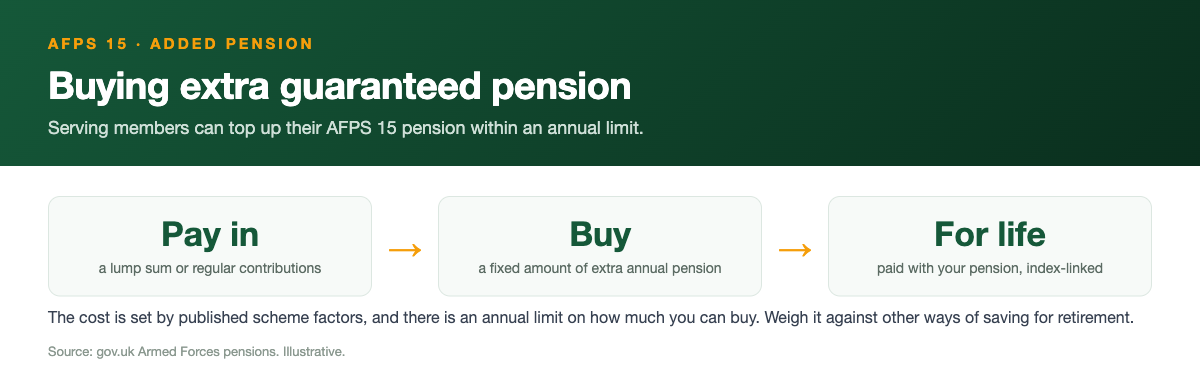
How the Added Pension estimate is worked out
Added Pension lets serving AFPS 15 members buy extra guaranteed pension, either by lump sum or regular contributions, within an annual limit.
The illustrator shows roughly how much extra annual pension a given outlay buys, so you can weigh it against other ways of saving for retirement. Costs are set by published scheme factors.
What AFPS 15 Added Pension actually is
Added Pension is the one approved way to top up your guaranteed armed forces pension from your own pocket while you are still serving. You pay extra, and in return the scheme adds a fixed amount of annual pension to your AFPS 15 record, on top of the 1/47th of pensionable pay it banks for you automatically each scheme year. It is not a side pot of money or an investment fund. It is a promise of more guaranteed income for life, paid by the scheme alongside the rest of your AFPS 15 benefits when they fall due.
Because Added Pension sits inside AFPS 15, it behaves like the rest of your career average (CARE) pension. While you are serving it is revalued each year so it keeps its value, and once it is deferred or in payment it rises in line with the Consumer Prices Index. That CPI link is the headline feature that makes it different from a typical workplace pot: the income is index linked for life. As a worked illustration of that link, pensions in payment rise by 3.8% from April 2026, and the same kind of CPI uplift protects Added Pension once it is being paid.
This page is an illustrator, not a quote. It is run by an independent site and is not affiliated with the MOD, Veterans UK or JPAC, and nothing here is regulated financial advice. The only binding figures come from the scheme administrator, because the cost of buying a given amount of Added Pension is set by the Government Actuary's Department and varies with your age and the current factors. Use the tool above to get a feel for the trade off, then confirm any decision against the official cost before you commit a penny.
How you buy it: lump sum or regular contributions
There are two routes to buying Added Pension, and you can use either or both. The first is a one off lump sum, paid in a single window each year that the scheme opens for this purpose. The second is regular monthly contributions taken from your pay over a twelve month period. The monthly route spreads the cost and suits people with steady income who would rather not part with a large sum in one go; the lump sum route suits anyone who has come into money, perhaps from a bonus or an inheritance, and wants to convert it into guaranteed pension.
Whichever route you pick, the mechanism is the same. You tell the scheme how much annual Added Pension you want to buy, or how much you are willing to spend, and the scheme applies the published Government Actuary's Department factor for your age to work out the price. Younger members pay less for the same slice of annual pension than older members, because the scheme expects to pay a younger person's pension for longer, so the factor moves with age. The factors are reviewed periodically, so the cost of the same £100 of annual Added Pension is not fixed forever.
You can also choose whether your Added Pension covers you alone (member only) or includes an uplift for dependants. The dependant option costs a little more because it buys a higher survivor benefit if you die. The calculator above keeps things simple by illustrating member only Added Pension, so treat any dependant cover as an extra layer to price separately with the scheme. The point of the tool is to show you how the deal breaks down, how many pounds of guaranteed annual income a given spend tends to buy, not to replace the official quotation.
The annual limits and the published factors
You cannot buy an unlimited amount. AFPS 15 caps how much Added Pension you can hold, expressed as a maximum amount of extra annual pension, and that ceiling is uprated over time so it keeps pace with inflation. There is also a practical limit set by your purchasing window: lump sum purchases happen in a defined period each scheme year, and regular contributions run as a twelve month arrangement that you renew if you want to keep buying. If you are close to the ceiling, the scheme will tell you how much headroom you have left before it accepts a purchase.
The price is driven by the Government Actuary's Department factors, the same family of actuarial tables that sit behind other AFPS conversions. Members will already know that AFPS 15 uses a fixed 12:1 factor when you commute pension for a tax-free lump sum at retirement, meaning £12 of cash for every £1 of annual pension given up, with commutation capped at 25% of your pension under the HMRC limit. Added Pension factors are a separate set, but they come from the same actuarial source and are published so the cost is transparent rather than negotiable.
Because the factors are age related and reviewed from time to time, two members buying the same £500 of annual Added Pension in different years, or at different ages, will not pay the same price. This is why the page can only illustrate the relationship and cannot print your exact bill. Treat the limits as firm and the cost as a live figure: check the current factor and the remaining headroom with the scheme administrator before you decide how much to buy.
Who Added Pension is for
Added Pension is open to serving members of AFPS 15, which since 1 April 2022 means every regular and reserve member who is still building service. If you joined from 1 April 2015 you have always been in AFPS 15. If you were in AFPS 75 or AFPS 05 with transitional protection, you moved into AFPS 15 on 1 April 2022 under the McCloud remedy, and your legacy benefits are protected and paid when originally expected. Either way, the pension you are actively building today is AFPS 15, and that is the pension Added Pension tops up.
It tends to appeal most to a few clear groups. People who joined later in life, or who took a career break, and who will not reach the longest possible service have fewer scheme years banking that 1/47th, so buying extra makes up some of the ground. Higher earners who have headroom in their annual allowance and want more guaranteed, index linked income in retirement are another natural fit. So are people who simply value certainty: Added Pension removes investment risk because the scheme, not a fund manager, carries it.
It is less obviously right for members who are very close to leaving, who have pressing short term needs for the cash, or who have not yet built the two years of qualifying service needed to earn a scheme pension at all. It is also worth thinking about alongside Early Departure Payment plans. If you are heading for the 20/40 point, where leaving regular service at or after age 40 with at least 20 years' service triggers EDP 15, your Added Pension feeds into the deferred pension that EDP is calculated from, so it is not wasted, but the timing of when you see the benefit changes.
How it compares with other ways of saving
The honest comparison is between certainty and flexibility. Added Pension gives you a guaranteed, CPI linked income for life, backed by the scheme, with no investment decisions to make and no fund that can fall in value. A private pension or an ISA gives you a pot you control, with the chance of higher returns but also the risk of lower ones, and the responsibility for managing it. Neither is automatically better; they answer different questions. Added Pension answers "how do I lock in more guaranteed retirement income", not "how do I maximise growth".
Against a Defined Contribution arrangement, the key difference is who carries the risk. In a DC pot you carry the investment and longevity risk, and at retirement you decide how to turn the pot into income. With Added Pension the scheme carries both, and the income is already defined. For many service personnel that certainty is worth a great deal, particularly given how secure the AFPS promise is. The trade off is that the money is locked into pension and you cannot draw it as a flexible pot.
It is also worth weighing Added Pension against simply not commuting as much at the end. At retirement AFPS 15 lets you commute pension for cash at 12:1, up to 25% of your pension. Giving up less pension for cash later is another way to keep more guaranteed income, and it costs you nothing up front. Added Pension is the opposite move: spending now to buy more guaranteed income later. Looking at both sides together, what you buy now and what you choose to keep at the end, gives you the full picture rather than half of it.
A worked example (illustrative)
Here is an illustrative example to show how the pieces fit together. It is not a quote, and the only firm figures are the scheme rates already on this site; the purchase cost itself depends on the live Government Actuary's Department factor for your age, which you must confirm with the scheme. Take a member on £47,000 of pensionable pay. In a normal year, AFPS 15 banks 1/47th of that pay into their pension record, which is £1,000 of annual pension for that single year, before any revaluation. That is the engine running in the background without any extra payment.
Now suppose the same member decides they want to add a further slice of guaranteed annual pension on top of what the scheme banks automatically. They would tell the scheme the amount of annual Added Pension they want, the scheme would apply the published factor for their age to set the price, and they would pay it either as a lump sum in the annual window or as monthly contributions across the year. The extra pension then joins their AFPS 15 record and is revalued and CPI linked in exactly the same way as the rest.
To see the long term value of that index link, picture the member already retired. Their whole AFPS 15 pension, including the Added Pension slice, rises with CPI each year. Using the published illustrative figure, a 3.8% increase from April 2026 lifts every £1,000 of annual pension by £38 that year, and the Added Pension portion rises by the same percentage. The lesson is that Added Pension is not a fixed amount frozen at purchase; once in payment it grows with prices like the rest of your scheme pension, which is exactly why people buy it.
How to check your own position
Start with what the scheme already holds for you. Your annual benefit statement and your online pension record show the AFPS 15 pension you have built so far and the amount of Added Pension, if any, you already hold. That tells you how much headroom remains against the maximum you are allowed to buy. If you cannot find it, the scheme administrator can confirm both your current Added Pension and your remaining allowance, which is the figure that actually limits a new purchase.
Next, get the live cost. Because the price turns on the Government Actuary's Department factor for your age, and that factor is reviewed over time, the only reliable number is the current one from the scheme. Ask for the cost of the specific amount of annual Added Pension you are considering, and ask for both the lump sum price and the equivalent monthly contribution, so you can compare the two routes on the same basis. The calculator above is there to help you frame that request, not to replace it.
Finally, sanity check the timing against your wider plan. If you want an official projection of your overall pension, that comes from Veterans UK, using form 12 if you are still serving or form 14 if your pension is preserved. Line up your Added Pension purchase with that forecast, your expected leaving date, and any EDP plans, so you can see the extra income in the context of everything else. For a decision of this size, many members also take regulated financial advice, which this site is not and does not provide.
Common mistakes and the tax treatment
The most common mistake is treating Added Pension like a savings account you can dip into. It is not. Once you have bought it, the money is locked into your AFPS 15 pension and you receive it as income when your pension is paid, not before. If there is any chance you will need the cash in the next few years, Added Pension is the wrong home for it. The second mistake is leaving a purchase to the last minute and missing the annual window, which means waiting another year.
On tax, the appeal of Added Pension is that your contributions normally receive pension tax relief in the same way as the rest of your AFPS contributions, which makes buying guaranteed pension efficient for many earners. The catch sits at the other end of the system: buying Added Pension increases the growth in your pension for the year, and pension growth counts towards your annual allowance. Higher earners, or anyone buying a large amount in one go, can push past their allowance and face a tax charge, so the relief and the allowance need to be looked at together.
A third trap is buying without checking how it interacts with the rest of your plan, including the McCloud remedy. If you are an affected member choosing between legacy and AFPS 15 benefits for the period from 1 April 2015 to 31 March 2022 through your Remediable Service Statement, make sure you understand which scheme your Added Pension sits in and how it fits that choice. Added Pension is bought within AFPS 15, so confirm the position before assuming it slots neatly alongside protected legacy benefits.
Next steps
If Added Pension looks like a fit, work through it in order. Use the illustrator above to get a feel for how much guaranteed annual income a given spend tends to buy, then ask the scheme administrator for the live cost of the exact amount you want, both as a lump sum and as monthly contributions, along with your remaining allowance. Those two numbers, the real price and your headroom, turn a rough idea into a decision you can actually make.
Before you commit, check the annual allowance angle if you are a higher earner or buying a large amount, request an official forecast from Veterans UK so you can see the extra pension in context, and consider regulated financial advice for a purchase of this size. Remember the timing: lump sum buys happen in a set window each year and monthly contributions run as a twelve month arrangement, so plan around those dates rather than against them.
Whatever you decide, keep the principle in view. Added Pension is a way to convert money now into more guaranteed, CPI linked income for life inside a secure scheme. That certainty is its strength and its limitation. Weigh it against keeping more pension at retirement instead of commuting at 12:1, against a flexible pot you control, and against your own need for accessible cash, and you will reach a decision that fits your situation rather than a generic one.
Frequently asked questions
Estimate only. These figures use published AFPS rates and the 2026 increase (3.8% CPI) to give a guide, not a formal forecast. See how we calculate for the exact method and assumptions.
Is it worth commuting your pension?
Weigh tax-free cash now against the guaranteed income you give up.
James Hartley
James Hartley spent 22 years in the British Army, including unit personnel administration and pensions and records duties, and now writes the scheme guides and scenario pages on this site. He is not a regulated financial adviser, so the content is general information rather than personal advice.
Sources: gov.uk Armed Forces pensions · GAD factors · Veterans UK · MoneyHelper.