
Military Pension Calculator (UK)
Estimate your UK military pension and tax-free lump sum across AFPS 75, 05 and 15, plus any Early Departure Payment. Pick the scheme that matches when you joined. This is also the MOD pension for service personnel, the Armed Forces Pension Scheme administered by Defence Business Services (Veterans UK). Two things it does not cover: MOD civil servants, who are in the Civil Service pension scheme, and US military retirement (High-3, REDUX and the Blended Retirement System), which is a separate system.
Your details
Scheme, pay & service
Your estimate
Pension, lump sum & EDP
EDP 05 (rises to 75% at 55)
How this is worked out
AFPS 05 accrues 1/70th of final pensionable pay per year, capped at 40 years of reckonable service. An EDP 05 income steps up to 75% of the preserved pension from age 55. Figures use published AFPS rates. See our methodology. Estimate only, not financial advice.
How the Military estimate is worked out
Your Military pension follows the Armed Forces Pension Scheme that applied while you served. Pick the scheme that matches when you joined, most careers touch more than one.
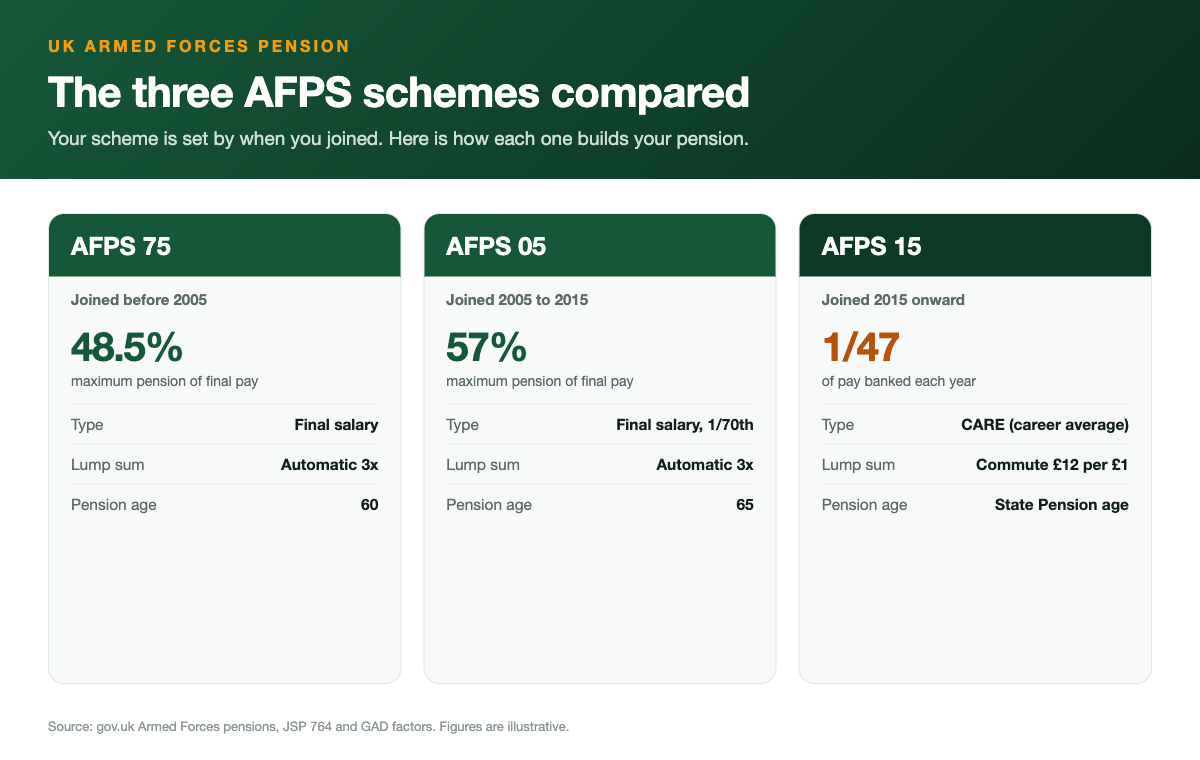
AFPS 75 is a final-salary scheme. Your pension is a share of representative pay for your rank, building to a maximum of 48.5% over a full career, 34 years for officers, 37 for other ranks, with an automatic tax-free lump sum of three times the annual pension.
AFPS 05 is also final-salary, building 1/70th of your final pensionable pay for each year served, up to about 57% of pay. It pays an automatic tax-free lump sum of three times your pension and can include an Early Departure Payment if you leave early with enough service.
AFPS 15 is a Career Average Revalued Earnings (CARE) scheme. It adds 1/47th of your current pensionable pay each year, revalued for inflation, rather than using a final salary. There is no automatic lump sum, so you can commute up to 25% of your pension for tax-free cash at a fixed rate of £12 per £1 of yearly pension given up.
Which military pension scheme you are in
There is no single UK military pension. There are three, and which one holds your service is decided by when you joined, not by which service you served in or what your job was. Everything else on this page follows from that one fact, so it is worth settling first.
| Scheme | You joined | How it works |
|---|---|---|
| AFPS 75 | 1 April 1975 to 5 April 2005 | Final salary, on the representative rate for your rank |
| AFPS 05 | 6 April 2005 to 31 March 2015 | Final salary, 1/70th of final pensionable pay per year |
| AFPS 15 | From 1 April 2015 | Career average (CARE), 1/47th of each year's earnings |
If you served across one of those boundaries you will hold benefits in more than one scheme, and each part is worked out under its own rules and paid at its own age. That is normal and it is not a mistake on your record. It does mean a single headline figure can hide two or three different payment dates, which is the detail most people miss until they are close to leaving.
One further complication applies to almost everyone who was serving on 1 April 2022. Under the McCloud remedy, members who were still in a legacy scheme moved into AFPS 15 on that date, and service between 1 April 2015 and 31 March 2022 became a choice rather than a fixed outcome. The McCloud remedy guide covers what you are choosing between. If you are not certain which scheme holds your service, which AFPS scheme am I in walks through it by join date.
How each scheme builds your pension
The three schemes reach an answer in genuinely different ways, which is why the same person with the same service can see very different numbers depending on where their time sits.
AFPS 75: rank and years, not your salary
AFPS 75 is the one people most often estimate wrongly, because it does not use what you were actually paid. For officers at OF-6 and below and for other ranks, the pension is based on your final pensionable rank and your length of reckonable service, applied to the representative pay rate for that rank. Two people who leave in the same rank with the same service normally receive the same pension, whatever their individual pay happened to be.
Accrual starts at age 21 for officers and age 18 for other ranks. The pension builds towards a maximum of 48.5% of representative pay at full service, which is 34 years for officers and 37 years for other ranks. The AFPS 75 calculator applies that structure directly.
AFPS 05: a straight 1/70th
AFPS 05 is the most predictable of the three. Each year of reckonable service earns you 1/70th of your final pensionable pay, up to a ceiling of 57% reached at 40 years. On top of the pension you receive an automatic tax-free lump sum of three times the annual pension. Run your own figures on the AFPS 05 calculator.
AFPS 15: career average, not final salary
AFPS 15 works on a Career Average Revalued Earnings basis. Each scheme year, running 1 April to 31 March, the MOD adds 1/47th of that year's pensionable earnings to your pension pot. There is no maximum number of years and it accrues from your first day of paid service, though most benefits need at least two years of paid service to qualify.
The word that matters in CARE is revalued. While you are serving, the pot is increased each year so that earlier years keep their value against current earnings rather than being frozen at what you earned a decade ago. Once you have left, or once the pension is in payment, it rises with the Consumer Prices Index instead. That is why entering your current pensionable pay in the AFPS 15 calculator gives a sound estimate of the whole pot rather than just this year's slice.
When a military pension is actually paid
This is the single most consequential thing an early leaver needs to understand, and it is where most confusion starts. Every scheme has two different ages, and they are not interchangeable.
Normal Pension Age is the age at which a member who is still serving can leave with an immediate pension. Deferred pension age, sometimes called preserved pension age, is when the pension is paid to someone who left earlier. Leaving at 40 does not mean drawing your pension at your scheme's Normal Pension Age. It means waiting for the deferred age, which is later.
| Scheme | Normal Pension Age | Deferred pension payable at |
|---|---|---|
| AFPS 75 | 55 | 60 for service before 6 April 2006, 65 for service after |
| AFPS 05 | 55 | 65 |
| AFPS 15 | 60 | State Pension Age |
The gap can be decades. Someone leaving AFPS 15 service at 40 has a deferred pension payable at State Pension Age, not at 60. The bridge across that gap, where one exists, is the Early Departure Payment, and it is a separate benefit rather than an early pension.
A preserved pension is not standing still while you wait. It is index linked, so its buying power is protected between the day you leave and the day it comes into payment, and it is uprated each April along with pensions already being paid. The April 2026 uprating is 3.8%. The preserved pension guide covers how that works in practice, and the rates and increases page lists the uprating year by year.
Leaving early: EDP and the AFPS 75 Immediate Pension
If you leave before your scheme's Normal Pension Age but have served long enough, you may qualify for money that starts now rather than decades later. The route depends entirely on your scheme.
EDP 05 and EDP 15
The Early Departure Payment is a bridging benefit: a tax-free lump sum plus a monthly income that runs until your deferred pension comes into payment. It is paid in addition to that deferred pension, not instead of it, and it does not reduce it.
| EDP 05 | EDP 15 | |
|---|---|---|
| Minimum age at exit | 40 | 40 |
| Minimum service | 18 years | 20 years (the 20/40 point) |
| Tax-free lump sum | 3 x preserved pension | 2.25 x deferred pension |
| Monthly income | About 50% of preserved pension | 34% of deferred pension, plus 0.85% for each year over 20 |
Both incomes are flat until age 55 and CPI uprated from then, with EDP 15 applying a catch up at 55 for the inflation of the intervening years. The EDP guide explains the difference in full, and the Early Departure Payment calculator runs your own service against both sets of rules.
AFPS 75 has no EDP
AFPS 75 does not use the EDP mechanism at all. Its early payment route is the Immediate Pension, which is a genuine pension in payment rather than a bridge. Officers reach it at 16 years of service from age 21, and other ranks at 22 years from age 18. If you are on AFPS 75 and someone quotes you an EDP figure, it does not apply to your service.
The tax-free lump sum and commutation
AFPS 75 and AFPS 05 both pay an automatic tax-free lump sum of three times the annual pension. You do not apply for it and you do not give anything up to receive it; it arrives alongside the pension.
AFPS 15 does not work that way. It pays no automatic lump sum. If you want tax-free cash from AFPS 15 you create it by commutation, giving up part of your annual pension in exchange. The scheme uses a fixed factor of 12:1, so every £1 of annual pension you surrender buys £12 of cash, and HMRC rules cap the amount you can commute at 25% of your pension.
That is a permanent trade. The pension you give up does not come back, and because the remaining pension is what gets uprated each April, giving up income also gives up a share of every future increase. Whether it is worth doing depends on what you need the money for and how long you expect to draw the pension. The commutation calculator shows the trade in pounds, and is commutation worth it works through when it tends to make sense and when it does not.
MOD pension, military pension, armed forces pension: one scheme, three names
People search for this in a dozen different ways, and the wording rarely changes the answer. A military pension, an MOD pension, an armed forces pension and a service pension all mean the same thing for someone who served: benefits under AFPS 75, AFPS 05 or AFPS 15, depending on when you joined. The same engine sits behind every version of this calculator, so the phrasing you pick does not change the maths.
Two genuine exceptions are worth stating plainly, because both send people to the wrong scheme entirely.
- MOD civil servants are not in AFPS. If you worked for the Ministry of Defence as a civilian rather than serving, your pension is the Civil Service pension scheme. Nothing on this page applies to it.
- US military retirement is a different system. High-3, REDUX and the Blended Retirement System are United States schemes. This tool covers the British Armed Forces Pension Schemes only.
If you served with a specific service and prefer that framing, the army pension calculator, RAF pension calculator and Royal Navy pension calculator run the same rules under service specific wording.
This page is an illustrator, not a quote. It is run independently and is not affiliated with the MOD, Veterans UK or JPAC, and nothing here is regulated financial advice. The binding figure for your own record is the one from the scheme administrator: see Veterans UK and how to get a pension forecast.
Frequently asked questions
Estimate only. These figures use published AFPS rates and the 2026 increase (3.8% CPI) to give a guide, not a formal forecast. See how we calculate for the exact method and assumptions.
Not sure which scheme you're in?
Find out whether you're on AFPS 75, 05 or 15 and how each builds up.
James Hartley
James Hartley spent 22 years in the British Army, including unit personnel administration and pensions and records duties, and now writes the scheme guides and scenario pages on this site. He is not a regulated financial adviser, so the content is general information rather than personal advice.
Sources: gov.uk Armed Forces pensions · GAD factors · Veterans UK · MoneyHelper.