
Armed forces pension on divorce
On divorce or the dissolution of a civil partnership, an armed forces pension is usually one of the most valuable assets to divide, often worth more than the family home. The courts can split it in three different ways, and the figure they work from is the cash equivalent value of the benefits you have built up. This guide explains how a pension sharing order works on AFPS 75, 05 and 15, where the valuation comes from, and the steps to take, though the order itself is a legal process for a family-law solicitor, not something this site can decide for you.
Key takeaways
- A pension is a marital asset; the court works from the cash equivalent value (CEV) of your AFPS benefits.
- In England, Wales and Northern Ireland the whole accrued value is in scope; in Scotland only the part built up during the marriage counts.
- There are three routes: a pension sharing order, pension offsetting, or an attachment order in England, Wales and Northern Ireland (in Scotland, an earmarking order against the lump sum only).
- A pension sharing order gives your ex-partner a percentage of the CEV as a pension credit, held inside AFPS and never transferable out.
- Your own pension is reduced by a matching pension debit for the rest of your life.
- Veterans UK provides the official cash equivalent value on request, with a separate value for each scheme you have been in; this guide is general information, not a valuation.
- Valuations now take months rather than weeks, and gov.uk's own figures disagree: up to 3 months in the July 2026 divorce note, up to 6 months on Form 19.
- Pension on divorce is a legal and financial decision, so a family-law solicitor and regulated advice are worth having.
What happens to a forces pension on divorce
A pension built up during a career is treated by the courts as a marital asset, in the same way as savings or property, and it has to be taken into account when finances are settled. Armed forces pensions are often the single largest asset in the marriage, precisely because they are generous and index-linked, so they rarely get left out of a settlement.
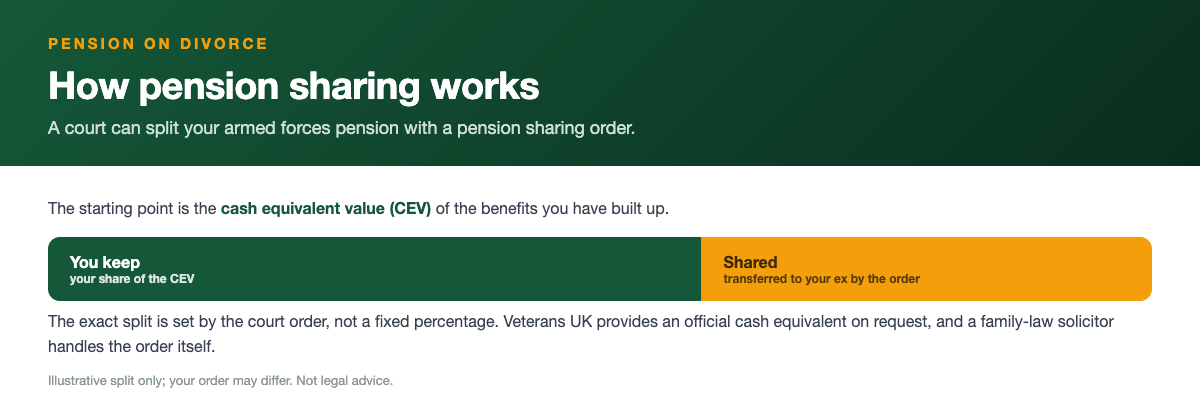
The starting point for any split is a valuation. For armed forces schemes that figure is the cash equivalent value (CEV), which puts a single capital figure on the benefits you have earned. Veterans UK provides this on request, and it is the number a solicitor and the court will work from rather than any estimate.
How much of the pension is in scope depends on where you divorce. In England, Wales and Northern Ireland the whole accrued value of the pension is on the table, not just the slice earned during the marriage. Scotland works to a different rule: only the proportion built up between the date of the marriage or civil partnership and the relevant date (the earlier of the date you stopped living together and the date the divorce summons was served) counts as matrimonial property, apportioned under regulation 4 of the Divorce etc. (Pensions) (Scotland) Regulations 2000. Veterans UK will not perform that apportionment, because it is not required to by law, so in a Scottish case it falls to your legal representative.
Whether you are still serving or already drawing the pension matters more than it looks. On AFPS 75, AFPS 05 and RFPS 05 the pension credit only carries an automatic lump sum if you were not already a pensioner when the order took effect. It changes how the pension debit is worked out, because the debit is an annual deduction whose size depends on how many pension years it is spread over. If your pension is already in payment there is usually an unavoidable overpayment of several months before the reduction is applied, and Veterans UK recovers it from you, under the same recovery process set out on our pension overpayment page. You also lose the free annual valuation once you have retired or are within 12 months of retirement age, so the divorce valuation is chargeable. As at August 2026 the scheme cannot yet implement a sharing order at all where the member was already a pensioner on the transfer day.
The court looks at the whole financial picture, so the pension sits alongside the house, savings and any other assets rather than being judged on its own, and how it is treated depends as much on the rest of the settlement as on the pension itself.
The cash equivalent value and where it comes from
Everything turns on the cash equivalent value, because that single capital figure is what the court, the solicitors and any actuary all work from. It is the scheme's estimate of what your accrued benefits are worth today, expressed as one number, and for the armed forces schemes only Veterans UK can produce the official version. The valuation method is prescribed by legislation, and Veterans UK works from tables of actuarial factors supplied by the Government Actuary's Department, which is why no public calculator can reproduce it. An estimate is useful for getting your bearings, but it is not the figure a court will accept.
It is worth getting the acronym right, because you will meet two of them. The MOD's 2015 Pension Remedy divorce information note says the cash equivalent value is sometimes referred to as a cash equivalent transfer value, or CETV, but that this term is only valid when pension benefits are not in payment. CETV is therefore a correct label for someone still serving or holding a preserved pension, and the wrong label for a veteran already drawing an armed forces pension, whose valuation is a CEV. CEV is the term used in MMP131, on Form 19 and in the MOD's 2026 guidance, so it is the one used here. If a solicitor or a form asks you for a CETV and you are already in payment, they mean the CEV.
You request the cash equivalent value from Veterans UK on Form 19, the request for an assessment of pension scheme benefits or cash equivalent valuation for divorce or dissolution proceedings. It now takes months rather than weeks, and gov.uk's own published figures disagree with each other. The MOD's 2015 Pension Remedy divorce information note, updated 24 July 2026, says new requests are taking up to 3 months to process. Form 19 itself, revision 07/26, says up to 6 months. Both sit on top of a backlog, because AFPS divorce valuations were suspended entirely from 19 May 2026 to 23 July 2026 while the actuarial factors were rebuilt after the SCAPE discount rate changed. Ask early rather than at the last minute, in the same way you would request an armed forces pension forecast well before a decision deadline.
There is no single figure covering everything. Veterans UK produces a separate cash equivalent value for each armed forces scheme you have been in, so a career split across AFPS 75 or 05 and AFPS 15 produces two values, not one combined one, and where a sharing order covers both a legacy scheme and AFPS 15 your ex-partner receives two separate pension credits. You are normally charged for only one valuation where the second is an AFPS 15 record sitting alongside earlier accrued rights. A CEV is generally valid for a year, and the way each value is made up affects how a share of it will actually pay out, which is the next thing to understand.
Form 19 is not the same as a Form 12 or Form 14 pension forecast. A forecast projects your own benefits at a chosen leaving date; a CEV is the capital figure produced for divorce proceedings and is the only one a court works from.
The three ways a pension can be divided
The cleanest route, and the one designed to give a clean break, is a pension sharing order. The court orders a percentage of the cash equivalent value to be moved from one party to the other, giving each their own pension provision from the date of the order. In Scotland a sharing order can specify a monetary amount instead of a percentage, and can come from a qualifying agreement rather than a court order; Veterans UK converts a money figure to the nearest whole percentage before implementing it.
The two alternatives are offsetting and, depending on where you divorce, an attachment or an earmarking order. Offsetting keeps the pension whole but balances its value against other assets, so one party might keep more of the house in exchange for the other keeping the pension. An attachment order is available in England, Wales and Northern Ireland: it leaves the pension in the member's name and directs part of it, which can be pension income, the retirement lump sum or a death benefit, to the former spouse when it is eventually paid. Scotland has no attachment order. It has an earmarking order, which can only be made against a pension lump sum, never against monthly pension payments.
Which route fits depends on what each party needs. Sharing gives a clean break and leaves each party with pension provision of their own; offsetting can appeal where one party would rather keep the house and the other keep the pension intact; attachment and earmarking tie the parties together for years, with the payment only arriving when the member draws the pension, the member taxed on the whole pension, and periodical payments under an attachment order stopping if the former spouse remarries. You cannot combine them: a sharing order cannot be made if an attachment or earmarking order is already in force against the same pension arrangement, and the reverse is also true. A solicitor will weigh these against the rest of the settlement rather than picking on the pension alone.
Two limits apply whichever route is chosen. Only pension benefits can be shared or attached: the Early Departure Payment, Armed Forces Compensation Scheme awards including a Guaranteed Income Payment, War Pensions, Armed Forces Attributable Benefits and Resettlement Grants sit outside all of it, although a court can still weigh them as a financial resource when it looks at offsetting, and the armed forces pension divorce calculator page sets out what that means in practice. And under an attachment or earmarking order the member stays liable for tax on the whole pension, with the sum paid across taken after tax has been deducted, which is a real difference when the parties are comparing the routes.
How a pension sharing order works on AFPS
Under a pension sharing order the court fixes a percentage of the cash equivalent value to transfer. That share becomes a pension credit for the receiving party and an equal pension debit against the member, so the member's own AFPS pension is permanently reduced by that amount for the rest of their life.
Because the armed forces schemes are unfunded public-service schemes, the pension credit stays inside the AFPS. It cannot be transferred out to a personal pension at all: AFPS 15 regulation 99(4) removes the transfer out right for any benefit attributable to a pension credit, and Veterans UK tells former spouses plainly that they cannot transfer benefits out of the armed forces schemes, nor add to them. The receiving party becomes a pension credit member with their own benefits in the scheme, and the credit is not aggregated with any other AFPS pension they may hold.
The credit is payable at pension benefit age, which is not the same thing as the scheme's pension age (in the AFPS 05 rules, pension age literally means 55). Pension benefit age is 65 on AFPS 05 and RFPS 05, and 65 on AFPS 75 for any order that took effect on or after 6 April 2006. On AFPS 15 the credit is payable at deferred pension age, which is State Pension age. A credit can be drawn early from 55 with an actuarial reduction for life, except on RFPS 05, where the early payment age for a pension credit member is 60.
For the receiving party, the pension credit is real pension provision in its own right, not a lump sum to spend now; it waits until pension benefit age in much the same way a preserved and deferred pension waits until its own payment age. For the member, the debit is permanent and does not shrink if circumstances change later, so it pays to be sure the percentage is right before the order is sealed rather than after.
If you are the former spouse
Veterans UK will not give you a valuation of your ex-partner's pension. Under the disclosure regulations the valuation goes to the member, or to the court, and a former spouse is entitled only to general information about the scheme, how the value is worked out and the schedule of charges. MMP131 puts it in terms: Veterans UK can only provide you with general information about the scheme, they cannot provide you with a valuation. If the member will not request it, your legal representative has to go back to court and ask the court to direct Veterans UK to produce it. Veterans UK also cannot tell you what percentage would give you an equal income, and cannot give you progress updates on a valuation request, because data protection limits that to the scheme member.
The forms are the practical part. Form 19 is the member's request for a cash equivalent valuation for divorce or dissolution proceedings. Once a sharing order is in place, Form 18 requests a forecast of your pension credit, and Form 8A is your claim for payment of the credit when it falls due. Form 20 is the separate claim for sums due under an earmarking or attachment order. Nothing is paid automatically: the onus is on the pension credit member to claim, and Veterans UK asks you to write to them at least three months before the pension is due.
A pension credit is yours for life. It keeps being paid even if you remarry or enter a new civil partnership, which is the opposite of an attachment order, where periodical payments stop on remarriage. It is also unaffected by your ex-partner's death, because a sharing order is a clean break. What it does not do is pass on as a pension when you die: MMP131 states that on your death, pension credit member benefits are not paid to surviving children, spouses or civil partners. Instead a lump sum goes to your estate, either the lump sum you had not yet taken or, if you die soon after the pension starts, the balance of a guarantee (three years on AFPS 75, five years on AFPS 05, RFPS 05 and AFPS 15). If a later marriage or civil partnership ends in divorce, the pension credit can itself be shared again.
How AFPS 75, 05 and 15 affect a fair split
A pension sharing order is expressed as a percentage of the cash equivalent value, but an equal split of that value does not always mean an equal split of useful pension, because credits in different schemes become payable at different ages. An AFPS 05 or RFPS 05 credit is payable at 65 and an AFPS 15 credit at State Pension age. An AFPS 75 credit follows the date the order took effect rather than the dates of the member's service: rule D.16(7) sets pension benefit age at 60 if the order took effect before 6 April 2006 and 65 otherwise, so any order made in the last twenty years produces a credit payable at 65. That is a different test from the one that fixes the member's own preserved AFPS 75 pension, which does turn on service before or after 6 April 2006. Two pension credits of the same cash value can therefore be worth quite different things.
The shape of the benefits differs too. AFPS 75 and 05 carry an automatic tax-free lump sum of three times the pension, while AFPS 15 has none and relies on commutation for cash, so the mix of income and lump sum behind a given value is not the same from one scheme to the next. For a pension credit there is a further condition: on AFPS 75, AFPS 05 and RFPS 05 no lump sum is payable with the credit if the member was already a pensioner when the order took effect. Where a career spans more than one scheme there is a separate value, and a separate credit, for each, so the split has to be looked at scheme by scheme.
This is exactly where a specialist can earn their fee. A pensions-on-divorce expert, often an actuary, can advise whether to share by equal value or to aim for equal income in retirement, which can mean different percentages for each party. It is general information here rather than advice, and the calculation behind a fair order belongs with Veterans UK figures and a professional.
The steps and how long it takes
The order is part of the wider financial settlement, so it runs on the timetable of the divorce rather than separately, and it starts with disclosure. Both parties set out all of their assets on the standard financial disclosure form used by the court, and the member or veteran asks Veterans UK for the divorce valuation on Form 19, which is a paper form returned by post. Get that request in early, because the valuation takes months rather than weeks and the rest of the negotiation usually waits on it. When the value comes back it goes onto the disclosure form alongside everything else, and that is normally the point at which the true scale of an armed forces pension becomes clear to both sides. The armed forces pension divorce calculator can show the rough scale of a given percentage while you wait for the official figure.
Once the values are known, the parties, with their solicitors and often a pensions actuary, work out a fair division of all the assets together rather than the pension in isolation. They might agree a pension sharing percentage, offset the pension against the house, or use a mix of the two. If they reach agreement it is written into a consent order and sent to the court for approval. If they cannot agree, the court decides, and in heavier cases a specialist report, known as a pension on divorce expert report, is commissioned to advise on a fair split. The aim throughout is fairness across the whole financial picture, balancing income in retirement against the capital needed now.
A sealed order does not take effect immediately. It takes effect on what the scheme calls the transfer day, which in England, Wales and Northern Ireland is the latest of the final divorce order, 28 days after the pension sharing order, or the determination of any appeal. The scheme then has a statutory implementation period of four months, set by section 34(1) of the Welfare Reform and Pensions Act 1999 and running from the later of the day the order takes effect and the first day Veterans UK holds every prescribed document and piece of information, which includes the charges being paid. In other words the four month clock does not start until the paperwork is complete and the bill has been settled. During that period Veterans UK sets up the pension credit and applies the debit to the member's record, and only at the end of it is the division final.
The charges are real and they are published. The MOD charging leaflet, dated 1 September 2016 and still the version linked from gov.uk in August 2026, sets a statement including a valuation produced specifically for divorce at £150 plus VAT each, an additional written reply that falls short of a reassessment at £75 plus VAT, and setting up the member's debit record together with the new pension credit member's record at a set £300 plus VAT per pension account. Setting up an attachment or earmarking order is £150 plus VAT. Putting a pension credit into payment, maintaining it and paying it are free. Basic information is free too, but the free transfer value it contains is not designed for divorce. The court decides who pays, and where the order says nothing the charge falls on the member. Those amounts have not been revised since 2016 and the leaflet reserves the right to review them, so confirm the current figures with Veterans UK before budgeting.
Scotland differs in mechanics as well as in scope. A Scottish valuation can be produced as at the historic relevant date, whereas in England and Wales the benefits can only be valued at a current date, and there is a separate charge of £150 plus VAT for that relevant date valuation. The order can specify a monetary amount rather than a percentage, and the share can be delivered by a qualifying agreement rather than by a court order at all. The transfer day is different too: in Scotland the order takes effect from the extract decree of divorce or of dissolution, rather than from the sequence used in England, Wales and Northern Ireland. Take advice that fits the jurisdiction you are divorcing in.
None of this is something you drive yourself: your solicitor handles the order and the scheme handles the mechanics. Because the figures and the legal process are both specialist, this is an area to get right first time. An order, once sealed and implemented, is very difficult to unwind, so the moment to check the value and the percentage is before it is made, not after.
What to do next
Start by requesting the cash equivalent value from Veterans UK on Form 19, because nothing can be settled without it, and use the pension on divorce calculator on this site only to get a feel for the scale of the pension while you wait. Pension on divorce is one of the areas where an estimate is least reliable, since the split depends on the official CEV and on how the wider settlement is balanced. Divorce is also the moment to review your death benefit nomination, which the armed forces survivor and widow pension guide explains.
Budget for the charges and for the wait as well. The divorce valuation is chargeable in most cases, implementation carries its own set charge per pension account, and the value itself is taking months rather than weeks to arrive, so the sequence to plan around is request first, negotiate second, and sign nothing until the official figure is in front of you.
There are three mistakes that come up again and again. The first is leaving the pension out of the settlement altogether, or swapping it away too cheaply to keep the family home: giving up a large, guaranteed, inflation linked pension to do that can leave one party comfortable now and poor in retirement. The second is working from a guessed or out of date figure rather than the official cash equivalent value. The third is settling on a handshake and never getting a consent order, which leaves the former spouse with no protected entitlement and can unravel years later. In a marriage where one partner deployed and moved repeatedly while the other built the home life, the pension often represents shared effort, and treating it as solely the serving member's is where a good many service divorces go wrong.
Tax is worth understanding before you choose between the routes. A pension sharing order does not itself trigger a tax charge at the moment it is made: it moves pension value across, and each party is then taxed in the normal way on the pension income they eventually receive, as income at their own rate when it is paid. The automatic tax-free lump sums under AFPS 75 and AFPS 05 keep their tax-free status within the usual HMRC rules. Under an attachment or earmarking order the member remains liable for tax on the whole pension and the sum paid across is taken after tax. Where a settlement uses offsetting instead, you are trading a pension against assets that may carry their own tax treatment, such as capital gains on a property, so the comparison is rarely like for like.
There is also one tax trap on the member's side that is easy to miss, because it arrives years after the order rather than with it. When a pension debit is recalculated, for example because an AFPS 75 or AFPS 05 member passes the immediate pension point and the deduction is then spread over more years, the debit falls and the annual pension due automatically rises. MMP131 calls this annual allowance re-referencing, and warns that in some circumstances that increase is picked up in the annual allowance calculation and can cause a tax charge. So it is accurate to say the order is not a taxable event, and misleading to stop there. If you are close to the annual allowance already, flag the pension debit to whoever does your tax.
Then take proper advice. A family-law solicitor handles the order itself, and for a pension of any size a regulated financial adviser or an actuary can check that the percentage being shared is fair once tax and the different pension ages are taken into account. This site is independent, is not affiliated with the MOD or Veterans UK, and provides general information rather than legal or regulated financial advice.
Above all, do not make commitments based on a rough number. Use an estimate to understand the scale and to ask better questions, request the official cash equivalent value from Veterans UK, and let your solicitor and, where the pension is substantial, a pensions actuary settle the figure that goes into the order.
See your own numbers
Get your pension, lump sum and EDP in seconds.
Frequently asked questions

James Hartley
James Hartley spent 22 years in the British Army, including unit personnel administration and pensions and records duties, and now writes the scheme guides and scenario pages on this site. He is not a regulated financial adviser, so the content is general information rather than personal advice.
Sources: gov.uk · GAD factors · Veterans UK · Forces Pension Society · MoneyHelper.