
Armed forces survivor and widow pension explained
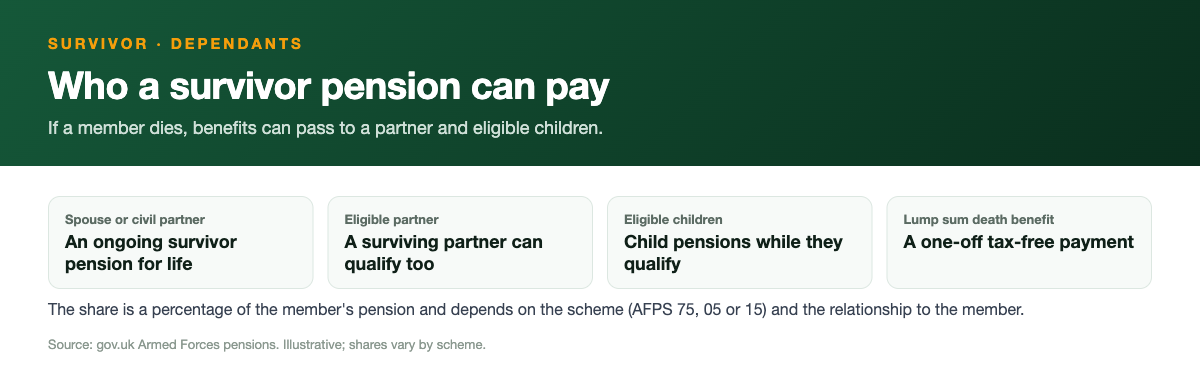
If a serving member or a pensioner dies, the armed forces schemes pay benefits to those left behind: an ongoing survivor pension for a spouse, civil partner or eligible partner, pensions for eligible children, and usually a tax-free lump sum death benefit. How much is paid depends on the scheme, whether the death happened in service or after leaving, and your relationship to the member. This guide sets out who qualifies and roughly how much each part is worth, but the exact figures come from Veterans UK.
Key takeaways
- A survivor pension is paid for life to a spouse, civil partner or, on AFPS 05 and 15, an eligible cohabiting partner.
- It is broadly half of the member's pension on AFPS 75 and around 62.5% on AFPS 05 and AFPS 15, though the exact rate depends on the scheme.
- Eligible children can receive their own pensions on top, usually while in full-time education.
- Death in service normally also pays a tax-free lump sum, for example up to four times pensionable pay on AFPS 15.
- The lump sum goes to whoever you nominate, so keeping a death benefit nomination up to date matters.
- Exact entitlements depend on your scheme and circumstances, so confirm them with Veterans UK.
Who can receive a survivor pension
A survivor pension is paid first to a husband, wife or civil partner. On AFPS 05 and AFPS 15 an eligible cohabiting partner can also qualify, provided the relationship meets the scheme's conditions, such as being financially interdependent and free to marry, and ideally backed by a partner declaration. The older AFPS 75 was historically more restrictive, so a cohabiting partner there should check their position carefully.
Eligible children can receive a children's pension as well, normally while they are under 18, or older if they remain in full-time education or cannot support themselves. These are paid on top of any partner's pension rather than instead of it.
How much a survivor pension is worth
As a broad guide, the survivor pension is around half of the member's pension on AFPS 75, and roughly 62.5% of it on AFPS 05 and AFPS 15. Where the member dies in service, the schemes generally base the survivor pension on an enhanced figure rather than only the pension earned so far, so a young family is not left with very little.
These percentages are a starting point, not a promise. The exact rate, and whether any short-term higher rate is paid in the first months after a death, depends on your scheme and your circumstances, which is why the survivor calculator here is only a guide and the binding figure comes from Veterans UK.
The lump sum death benefit
On top of the ongoing pension, a death in service usually pays a one-off tax-free lump sum death benefit. On AFPS 15 this is typically up to four times your pensionable pay, and the legacy schemes pay their own multiples, so it is a significant sum designed to give a family immediate financial security.
Crucially, this lump sum is paid to whoever you have nominated, not automatically to your spouse, so it can be directed to a partner, children or anyone else you choose. That makes keeping your death benefit nomination current one of the most important and most overlooked admin tasks, especially after a marriage, divorce or new relationship.
What to do next
If you are planning, check that your death benefit nomination reflects your current wishes and, on AFPS 05 or 15, make sure any eligible partner is declared so they are not left arguing their case at the worst possible time. Use the survivor calculator to get a feel for the ongoing pension, then confirm the detail with Veterans UK.
If you are claiming after a bereavement, contact Veterans UK as soon as you can; they administer the benefits and will confirm exactly what is payable. This is an independent information site, not affiliated with the MOD or Veterans UK, and provides estimates rather than regulated financial advice.
See your own numbers
Get your pension, lump sum and EDP in seconds.
Frequently asked questions

James Hartley
James Hartley spent 22 years in the British Army, including unit personnel administration and pensions and records duties, and now writes the scheme guides and scenario pages on this site. He is not a regulated financial adviser, so the content is general information rather than personal advice.
Sources: gov.uk · GAD factors · Veterans UK · Forces Pension Society · MoneyHelper.