
Armed forces pension CETV explained
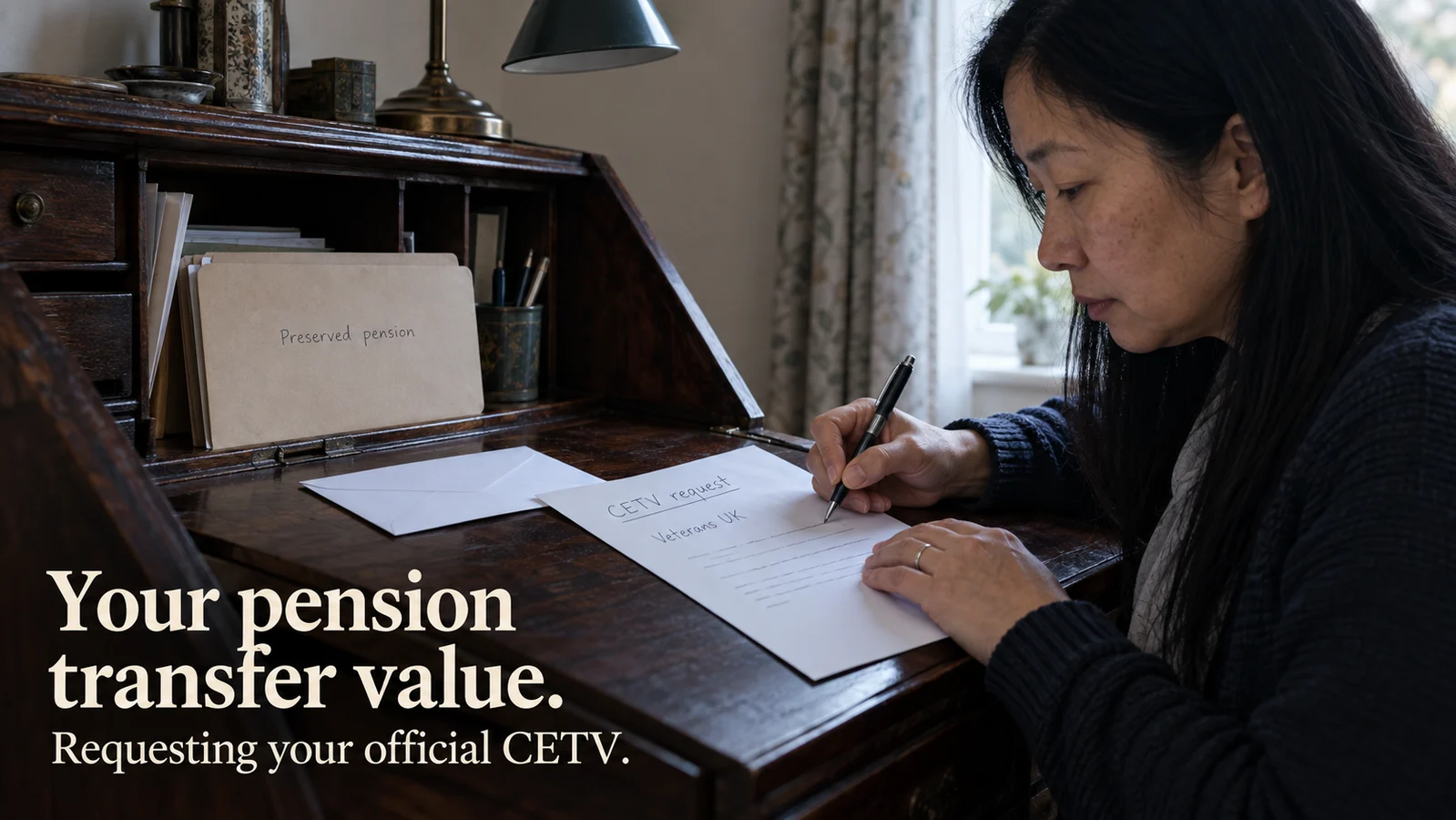
A CETV, or cash equivalent transfer value, is the capital sum the armed forces pension scheme puts on the pension you have built up. You need one to transfer a preserved AFPS pension to another scheme, and the same kind of figure, called a cash equivalent value, is what the court divides on divorce. This guide covers who can get one, how to ask Veterans UK for it, where an AFPS pension can and cannot go, and why no honest website can calculate it for you.
Key takeaways
- A CETV is the capital value of a pension not yet in payment. Veterans UK issues it, not Equiniti Paymaster.
- You ask in writing to DBS Veterans UK Pensions Division; there is no form for a transfer. For divorce the form is AFPS Form 19.
- A preserved member can have one free statement, including a CETV, in any 12 months, and the value is guaranteed for 3 months.
- An AFPS pension can only be transferred to a scheme that does not allow cash to be drawn out, so personal pensions and drawdown are ruled out.
- Veterans UK suspended divorce valuation charges from 19 May 2026, except for a second valuation within 12 months.
What a CETV is, and why transfer values move
Your armed forces pension is a promise of a guaranteed yearly income, rising with inflation, for life. A cash equivalent transfer value turns that promise into a single capital figure: the amount the scheme would pay into another pension scheme to take over the benefits you have built up. It is usually many times the yearly pension, because it has to stand in for decades of index-linked payments.
The Pension Schemes Act 1993 gives you a right to one. Section 93A says the scheme "must, on the application of any member, provide the member with a statement of entitlement", a written statement of "the amount of the cash equivalent at the guarantee date". In divorce the MOD calls the same kind of figure a cash equivalent value, or CEV.
The figure is worked out by Veterans UK using factors from the Government Actuary's Department. Three things move it. Your age matters, because the closer you are to pension age, the sooner payments start. The discount rate matters, because public service schemes value future payments using a rate set by HM Treasury, called the SCAPE rate: on 19 May 2026 the Treasury changed it from CPI plus 1.7% a year to CPI plus 2.0%, and every scheme received new CETV factors within 11 working days. And the pension itself matters, revalued to the guarantee date.
This is why two CETVs for the same pension, a year apart, can differ by more than the year's pension increase would suggest. Neither MOD nor GAD has said how much the 2026 change moved AFPS values, so treat any figure older than May 2026 as out of date.
Who can get a CETV
The statutory right to a cash equivalent applies to a member who has accrued rights, whose pension has not started, and who has stopped building up benefits, at least one year before normal pension age. In practice that means a preserved, or deferred, member: someone who has left the Regulars without an immediate pension.
Three groups cannot get one. AFPS Form 19 says: "If you are already receiving a pension or have completed sufficient service to qualify for an immediately payable pension, if we assumed retirement on the date of the statement you cannot transfer your pension and therefore, cannot be provided with a CETV." And a pension credit, the share a former spouse receives under a pension sharing order, cannot be transferred out.
Short service has its own rule on AFPS 15. If you leave with less than two years, the scheme booklet says: "You must have completed a minimum of 3 months' Service, and you must apply to DBS Veterans UK within 6 months of leaving the Armed Forces and before State Pension Age." Our guide to the armed forces pension cash transfer sum covers that position for all three schemes.
How to get your official CETV from Veterans UK
Veterans UK issues CETVs and handles transfers out, because it administers pensions that are not yet being paid. Equiniti Paymaster only pays pensions already in payment, and a pension in payment cannot be transferred, so it has no part in this.
- For a transfer: apply in writing to DBS Veterans UK Pensions Division, Mail Point 480, Kentigern House, 65 Brown Street, Glasgow, G2 8EX. There is no transfer form on the Veterans UK forms page.
- For divorce: use AFPS Form 19, the request for a cash equivalent valuation for divorce or dissolution proceedings.
- Questions: the JPAC Enquiry Centre on 0800 085 3600, or [email protected].
Form 19 says you are "legally entitled to one free basic statement of benefits within any 12 months period", and that a preserved member is entitled to a free CETV assessment. The AFPS 05 and AFPS 15 rules allow a second application within 12 months; whether that one is charged is not published, so ask.
Timing is tight once the statement arrives. The guarantee date must fall within three months of your application, or six months if the delay is beyond the scheme's control. You then have three months from the guarantee date to apply to take the transfer, and for a final salary or career average pension you must do so at least one year before normal pension age. Miss the window and you start again with a new statement.
A Form 12 or Form 14 forecast is not a statement of entitlement. It estimates your pension, not its transfer value.
Transfers out: what AFPS members should check first
Since April 2015 an AFPS pension can only go to a scheme where the benefits are not flexible. The rule is section 95(2A) of the Pension Schemes Act 1993, inserted by the Pension Schemes Act 2015, and it applies to every unfunded public service defined benefit scheme. gov.uk puts it this way: "the government has prevented transfers from unfunded public service defined benefit schemes (such as the AFPS) to funded defined contribution schemes in UK or abroad."
The scheme booklets say the same in plain terms: you can only transfer "to a scheme that does not allow you to take cash from your pension (known as a pension drawdown)". So a personal pension, a SIPP or a workplace defined contribution scheme cannot receive an AFPS transfer. Another defined benefit scheme can.
The most common route is a move into another public service job. Transfers between schemes in the Public Sector Transfer Club have their own time limit: the AFPS 15 booklet says you "must apply within 12 months of joining the new pension scheme and before your pension is due to be paid", and the AFPS 05 rules set the same one-year limit. Ask your new scheme whether it is a Club member before the year runs out.
A transfer is final. Once paid, your AFPS rights are extinguished, including the benefits for a spouse or partner, so compare what the new scheme will credit you with against the preserved pension you give up. The legal requirement to take independent advice on transfers over £30,000 applies to moves into flexible benefits, which the AFPS does not allow, so it does not bite here. The MOD still says members are "strongly advised to take independent financial advice about transferring benefits before making a decision".
Transfers abroad are not straightforward. gov.uk rules out transfers to defined contribution schemes abroad, and the position for overseas defined benefit schemes is not settled in anything the MOD publishes, so ask Veterans UK before assuming it can be done.
CETVs in divorce and pension sharing orders
On divorce or dissolution, the court works from the cash equivalent value of each armed forces scheme you have been in. You request it on AFPS Form 19, and Veterans UK produces a separate value for each scheme. A pension sharing order then moves a percentage of that value to your former spouse as a pension credit. Our guide to armed forces pensions on divorce covers the orders themselves.
Charges are suspended for now. Form 19, revised in July 2026, says: "We have temporarily suspended charging for all members with effect from 19 May 2026, pending the implementation of new factors from the Government Actuary's Department (GAD). Please note that charges will still apply where more than one Cash Equivalent Value is requested within a 12-month period." The normal charge for a valuation designed for divorce disclosure is £150 plus VAT, £180 in total, per scheme.
The free yearly statement is not designed for divorce disclosure, and members already receiving a pension, or entitled to an immediate one, get a CEV rather than a CETV. The same form says new requests are taking up to six months, so ask early. To size the pension before the official figure arrives, the military pension divorce calculator estimates the yearly pension being shared.
Why this page has no CETV calculator
Every AFPS CETV is built from the Government Actuary's Department's factor tables, which GAD publishes for scheme administrators. Its terms say the factors and guidance "must not otherwise be reproduced, distributed or communicated in whole or in part to any other person without GAD's prior written permission". A calculator that applied them would be doing exactly that.
Any tool that offers you an AFPS transfer value without those factors is guessing. The only figure you can rely on, for a transfer or for a court, is the statement Veterans UK issues, and it is free once a year. The preserved pension calculator will tell you the yearly pension the CETV is based on, which is the figure to sanity-check first.
See your own numbers
Get your pension, lump sum and EDP in seconds.
Frequently asked questions
Armed Forces Pension Calculator Team
We build the calculators and write the guides on this independent site, working from the official AFPS scheme rules and published sources such as gov.uk, Veterans UK and the Government Actuary's Department. We are not part of the MOD and we are not regulated financial advisers, so everything here is general information, not personal advice.
Sources: gov.uk · GAD factors · Veterans UK · Forces Pension Society · MoneyHelper.